Collimating a Newtonian
My main scope is a 12" f/4 Newtonian with an ASA Wynne corrector and an ASI2600MM. At f/4 there isn't much room for error. If the collimation is a little bit out, the stars will be noticeably out of shape.
I do the collimation in two stages. First I get it as close as I can in the daytime with the Catseye tools, then I finish it at night using the camera on defocused stars.
In the daytime
The primary has a Catseye Hotspot in the centre. I start with the secondary, using a Catseye Teletube XLS sight tube to centre it under the focuser and point it at the hotspot. Then I adjust the primary while looking through the Catseye Infinity XLK autocollimator, until the reflections of the centre spot stack up on top of each other.
The primary cell has 3 spring-loaded pull screws and 3 locking push screws. I've fitted heavy-duty springs to the pull screws, which hold the mirror more firmly than the original ones when the locking screws are disengaged. I back off the locking screws before I start adjusting, then tighten them up again when I'm finished.
This gets it close, but the last bit has to be done on the stars.
On the stars
With a Wynne corrector, a tilted primary gives the same coma everywhere in the frame. If the scope isn't properly collimated, defocused stars will look like a lopsided donut, with the central shadow off centre. Working out which screw on the primary mirror to turn, which way and how far is the hard part.
So I wrote an app to make it much easier. The code is on GitHub at exploded/collimation. It's a single executable that runs on the imaging PC alongside N.I.N.A. You use it from a browser, so I can stand at the back of the scope with my phone.
A measurement takes about a minute. The app moves the focuser 500 steps inside and outside focus, takes three 5-second frames on each side, and stacks the isolated stars. It fits a model of the donut to both stacks and works out where the primary's optical axis lands on the sensor, measured in millimetres. The screen shows that as a dot on a target, along with the screw to turn and by how much.
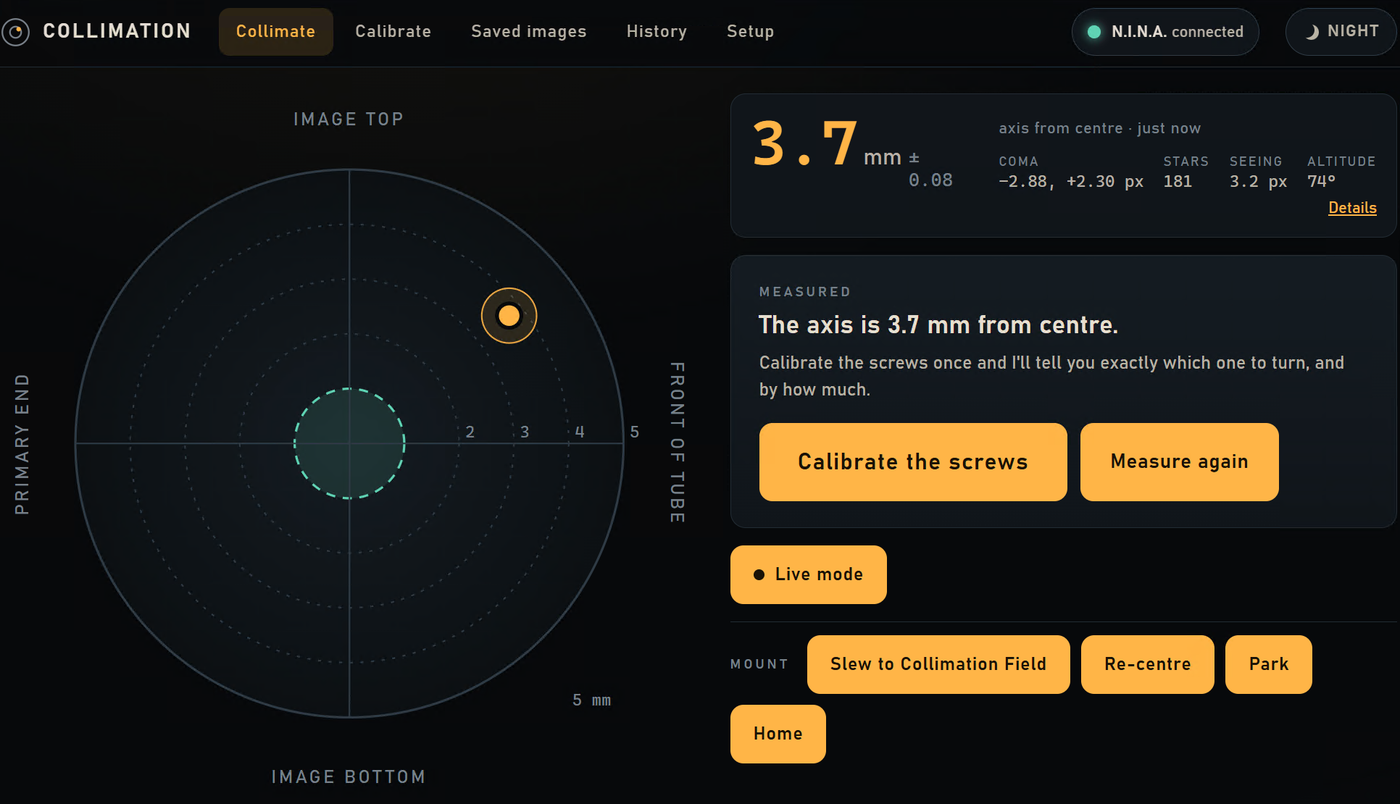
The app doesn't need to know where the screws are or which way the camera is rotated. Put labels A, B and C on the three primary screws and the app asks you to turn each one in sequence. It measures how far the stars move after each turn, and from that it learns what each screw does. From then on it tells you which screws to turn and by how much, rounded to 1/16 of a turn, to get the scope collimated.
There's also a live mode that loops exposures while you turn the screws, so you can watch the dot move.
First night
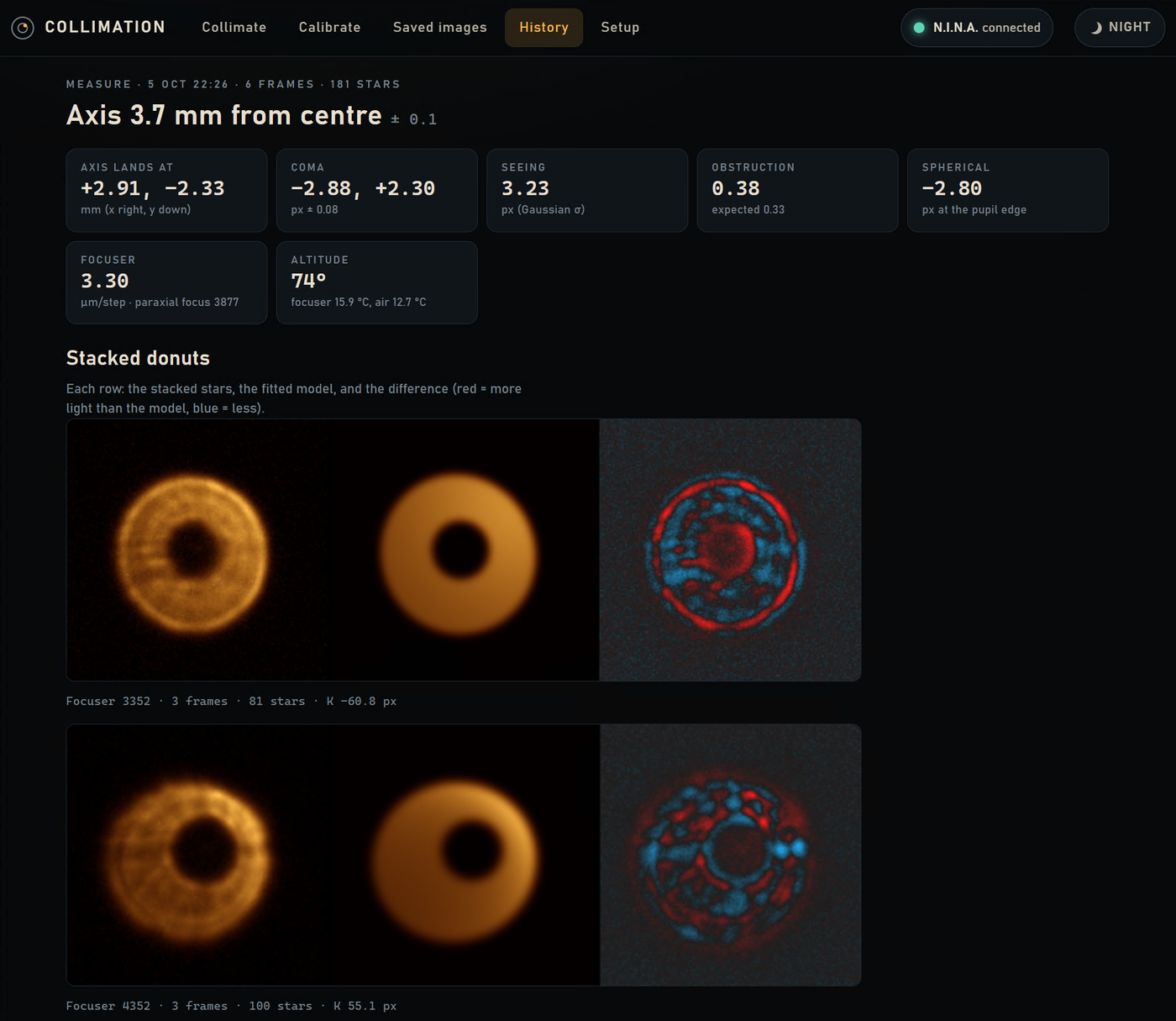
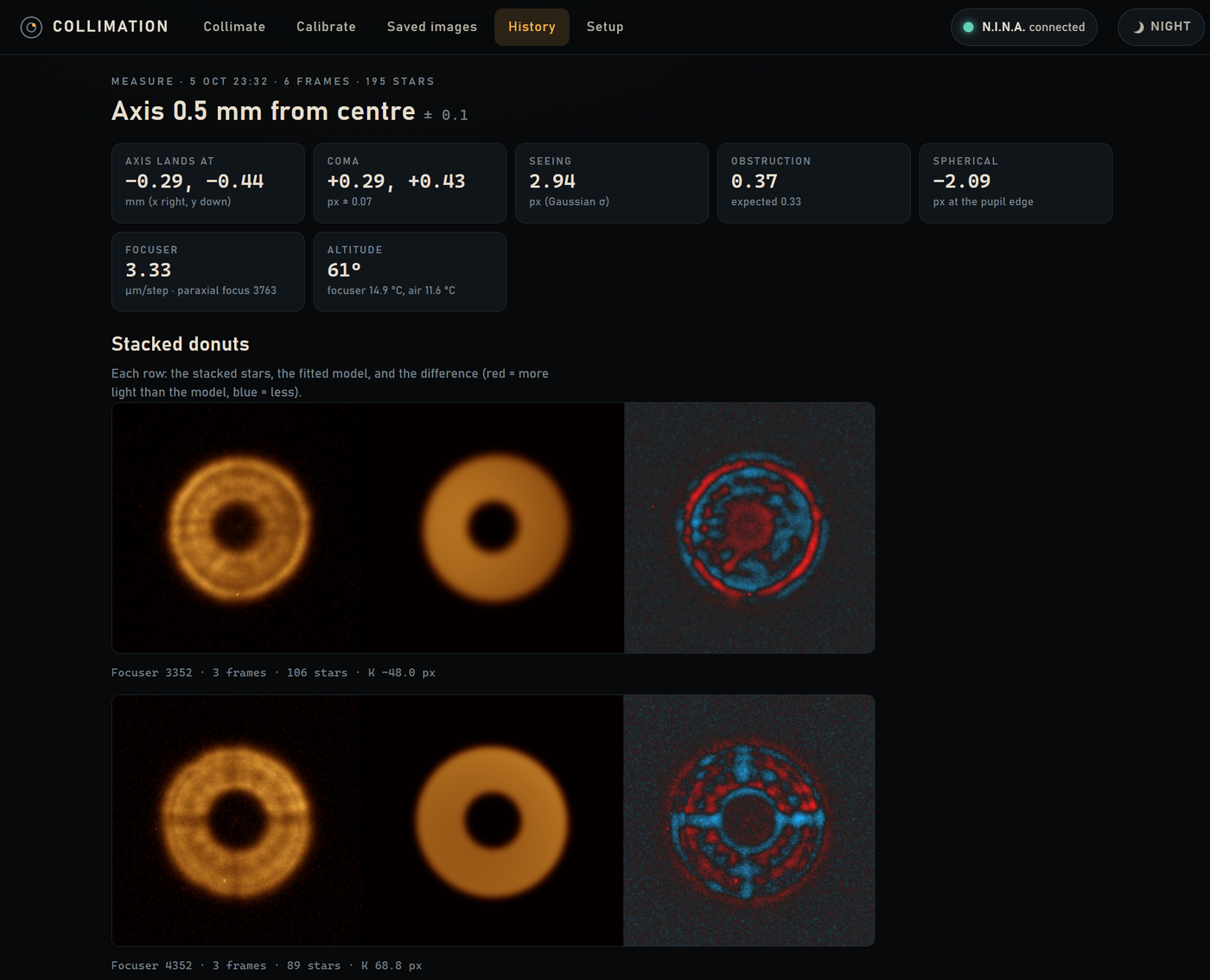
On 5 October 2026 it took the primary's axis from 3.7 mm off centre to 0.5 mm. I'm aiming for under 1 mm with f/4 and a corrector over an APS-C sensor.
| Before | After | |
|---|---|---|
| Axis from centre | 3.7 mm | 0.5 mm |
| Coma (x, y) | −2.88, +2.30 px | +0.29, +0.43 px |
| Altitude | 74° | 61° |
Before
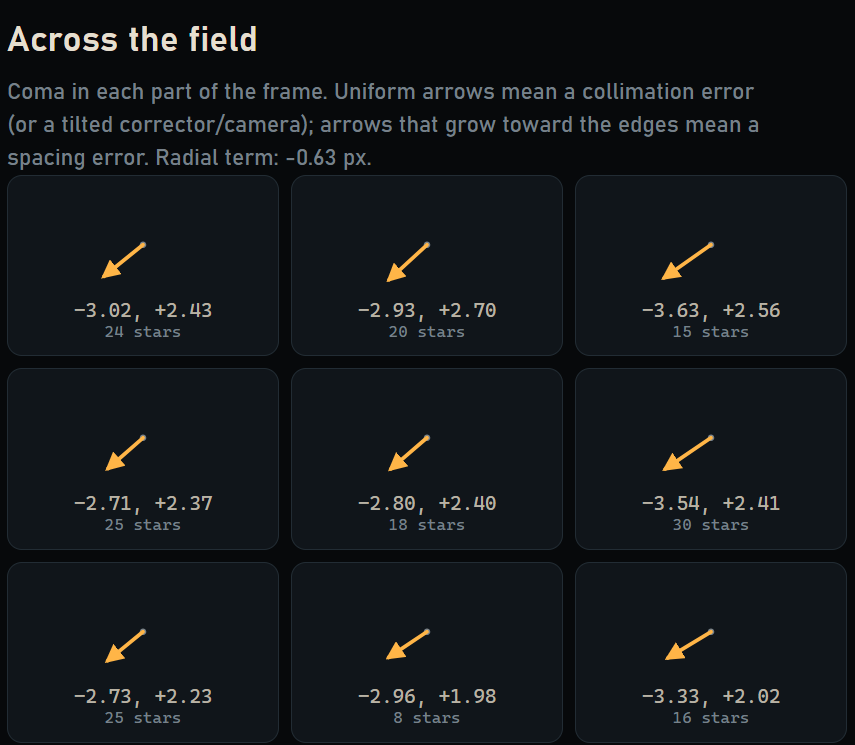
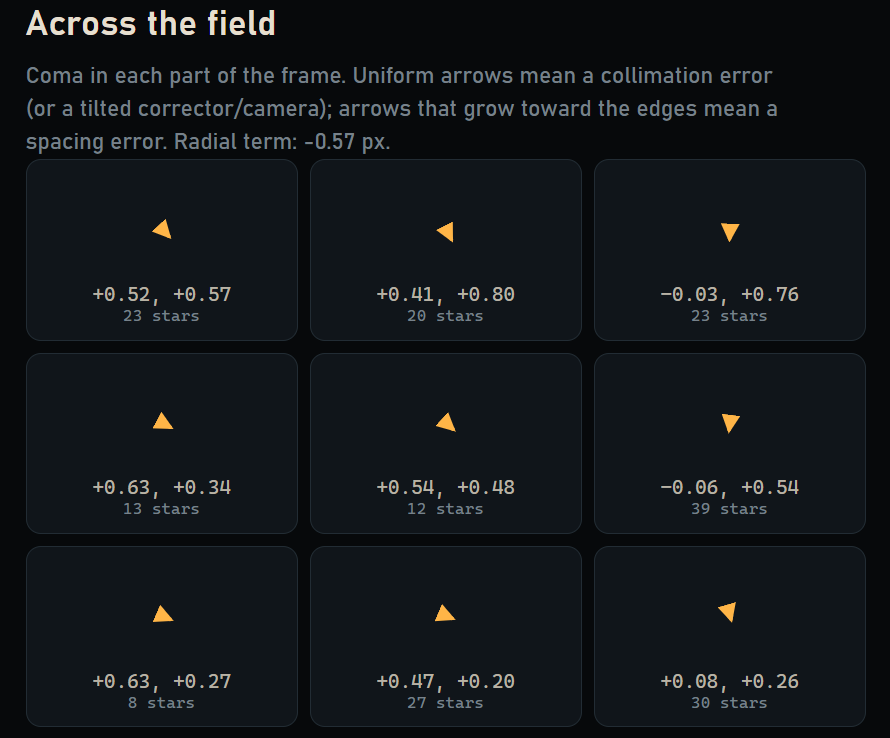
The donuts are lopsided, and all nine regions of the frame show coma pointing the same way. That means the mirror is tilted.
After
The donuts are round. What's left is small and gets bigger towards the edges. That's corrector spacing, not collimation, and the mirror screws can't fix it.
Try it
You need N.I.N.A. with the Advanced API plugin, and the camera, focuser and mount connected in N.I.N.A. I built it for my scope, but the settings aren't specific to it. The README has the build steps and more detail on how the measurement works.